

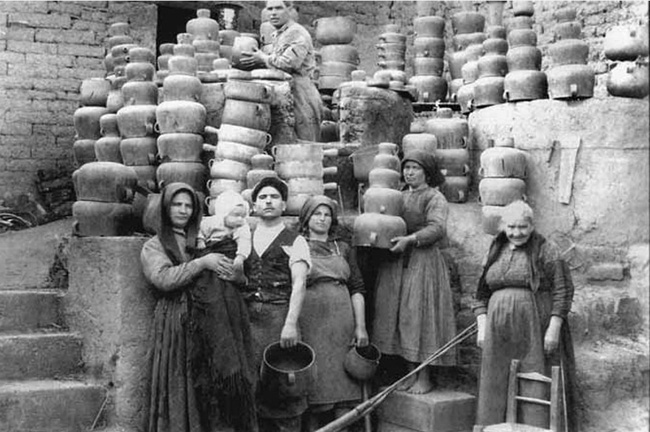
Pottery making in the pre-industrial Sardinia was carried out by workers who mostly lived in specific towns to meet local needs. Unlike other crafts, widely carried out in the territory and incorporated into the home activity system, such as weaving, basket making and some forms of woodworking, pottery required expertise and specific tools and equipment.
Production centers were located mainly in the area of the Campidano. Popular pottery productions made by master potters were created in Assemini and Oristano, as well as in Pabillonis, specialized in the manufacturing of pots and pans.
Different types
Until the beginning of last century, artefacts were crafted in small numbers and were functional to meet the daily demand of farmers and shepherds: jugs, marigas, containers, sciveddas, pans,pingiadas, jars, frascus, plates and bowls, discus, and pitchers. Other productions were related to construction, such as the manufacture of tiles and mats of circular shape, used for the outer cover of church domes – pipes and gutters and other functional elements, such as vases for norias - wheels for water collection.
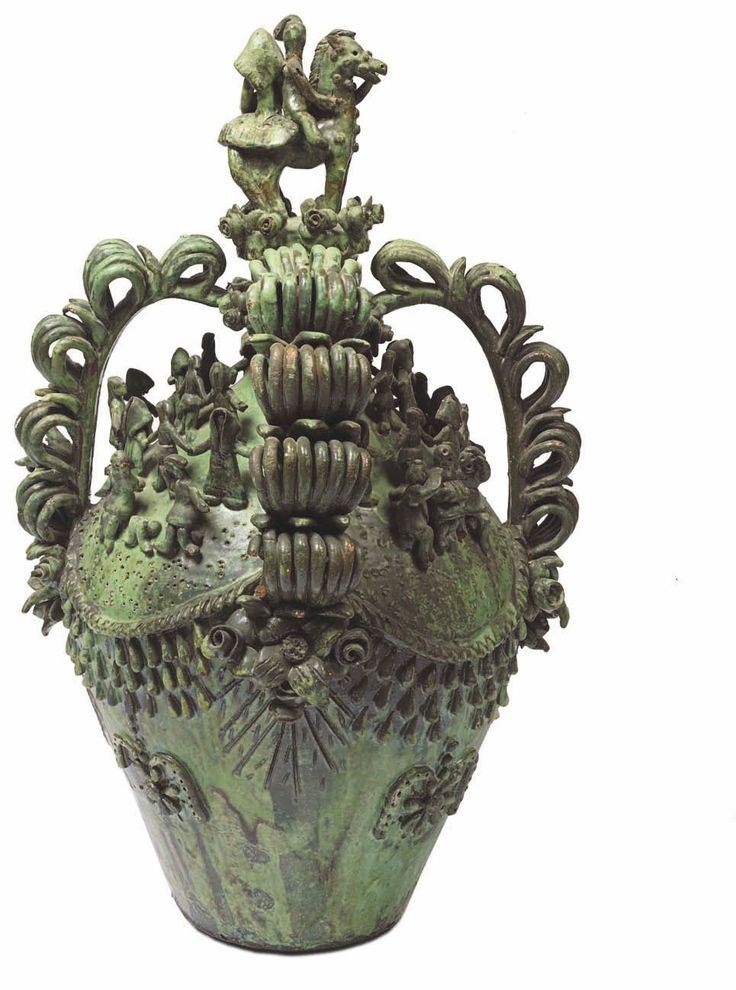
The pitcher, called mariga and several other local variants, is among the items that best represent the traditional crafts of ceramics in Sardinia. This production is characterized by a variety of models designed for a purely functional use, transportation, conservation and water purification, rather than for decorative, ceremonial and festive purposes. In the production of daily use, jugs were produced in series and in different sizes, generally four, based on the amount of litre content. They also featured handles, necks and bellies of different sizes. These variations, in addition to differentiate their creators, were also an indication of the area they came from. Festive productions were different, characterized by the uniqueness of the objects, individually made by skilled craftsmen. The bride's jug, is an element of traditional bridal trousseaux. Its peculiar crafting is different based on the wealth of the bride and can consist of simple decorative carvings and good-luck symbols or twisted necks, up to the elaborate and sophisticated additions of plastic leaves, birds, angels, and human figures. Festive versions also include the four-handled pitcher, a quattru marigas.
Another artefact typical of Sardinian traditional production is the jug, also referred to as frascu, stangiada and other local versions: a terracotta water jug featuring a rounded belly, that lies horizontally. Just like the pitchers, the jugs were also available in regular and festive versions. The latter were fully glazed, while those of daily use were glazed only on their necks and handles. Many versions feature rounded bellies, with only one flattened side, having the shape of a keg.
The containers called sciveddas are available in different local versions, simple widespread artefacts, made of terracotta, with a truncated cone shape. They were mostly used to prepare doughs, pasta and pastries and for the preparation of fregola. Traditionally they were mass-crafted in different sizes, depending on the intended use and the place where they were made. Glazed on the inside, on the edge they featured two small holes for the passage of a pendant that made it possible to hung them on the wall.
The cutlery made of ceramics includes traditional plates and bowls, prattus and discus. They were used to serve and eat food at mealtimes. These simple-shaped objects with flat bottom and top edge are usually undecorated when intended for a daily use, while more elaborate and decorated ones for festive use. They were stored in the kitchen on the typical wooden plate rack, su parastaggiu.
Online reference
Books
G.V. Arata, G. Biasi, Arte Sarda, 1986 (reprint of the 1935 original), Carlo Delfino publisher, Sassari
V.Mossa, Artigianato Sardo, 1983, Carlo Delfino Editore, Sassari
V.V.A.A., Ceramiche. Storia, linguaggio e prospettive in Sardegna, Ilisso Edizioni, Nuoro
I. Amerigo, Piccole industrie sarde, 1928, Bestetti & Tumminelli, Rome & Milan
Musei artigiani e botteghe storiche - Artisan museums and historical workshops, 2009, Regione Autonoma della Sardegna, Assessorato del turismo, artigianato e commercio
Video
Cento anni di Ceramica, mostra allestita dall’ISOLA nel Padiglione Tavolara di Sassari, 2001
Artigiani della creta, part of “La mia terra è un’isola” by Fiorenzo Serra, 1954. Illisso Editore
Antico artigianato sardo, Procedure della ceramica tradizionale, 1956
Assemini, interview with Doriana Usai, Roberto Mileddu, directed by Gianfranco Cabiddu
Ceramic art by Siniscola Deiana brothers
Sound recording and reproduction
I maestri dell’arte paesana, interview by Fernando Pilia to Pabillonis potters, 1964-65
I maestri dell’arte paesana, interview by Fernando Pilia to Oristano potters, 1964-65
I maestri dell’arte paesana, interview by Fernando Pilia to Dorgali potter Michele Pilia, 1964-5
Ci metto le mani, Eccellenza artigiana in Sardegna. Interview by Raffaella Venturi to Assemini potter Luigi Nioi